
At Catalyx, we specialize in **bridging the gap** between businesses and their IT service providers.
At Catalyx, we specialize in **bridging the gap** between businesses and their IT service providers.
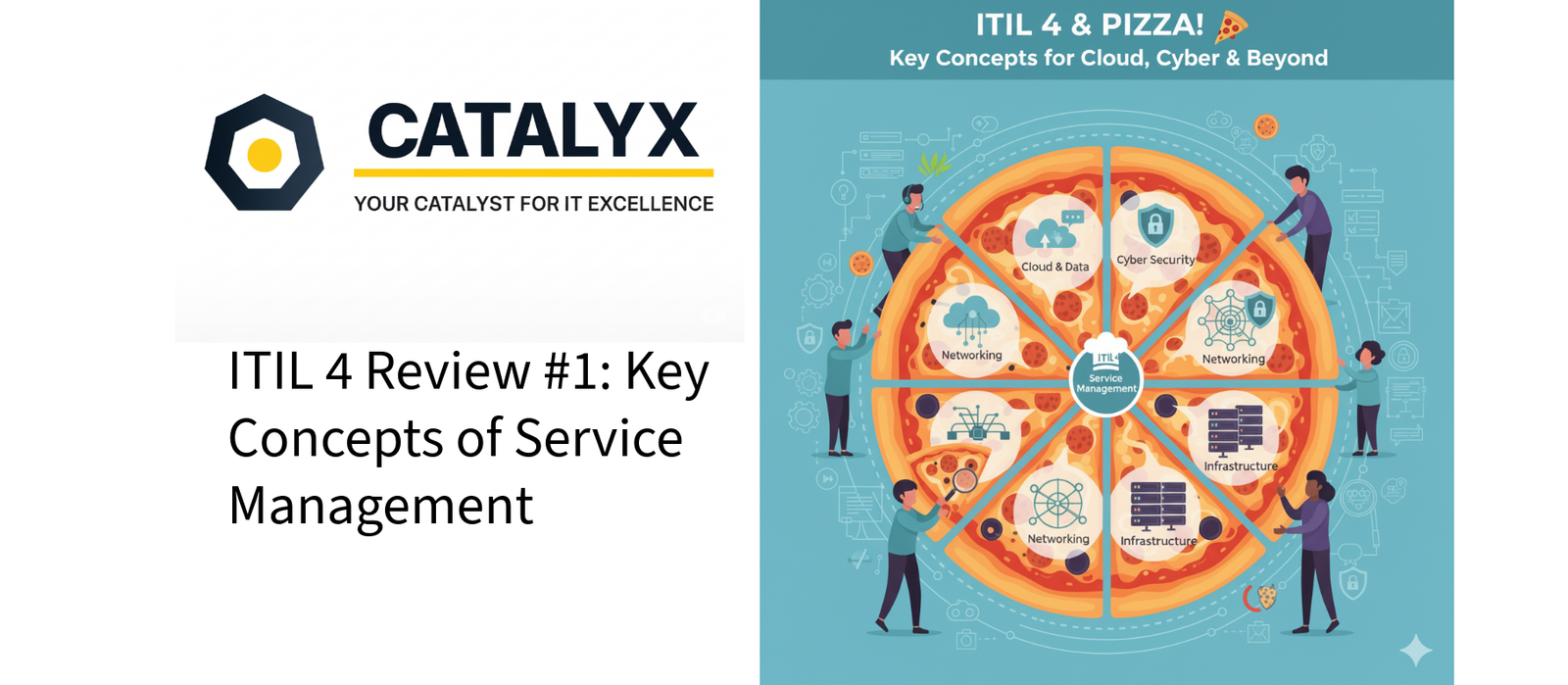
Yesterday, I shared why experience + best practice is such a powerful combination — it helps us reduce firefighting, automate routine work, and free up time for real improvement.
Today, let’s start with the foundations of ITIL 4 — the Key Concepts of Service Management. But instead of throwing textbook definitions at you, let’s make it fun (and relatable) using pizza as an example… and then see how this applies to some of the Platforms such as Cloud, Infrastructure, Cyber, Data, and Networking teams.
A service delivers value without you managing all the complexity behind it.
🍕 Pizza Example: You just enjoy your pizza — you don’t knead dough or fire up the oven. 💻 In Tech: Microsoft 365 lets users collaborate without you running mail servers or patching Exchange.
How the provider organizes people, process, and tools to deliver the service reliably.
🍕 Pizza Example: The restaurant manages suppliers, staff, recipes, oven maintenance, and delivery. 💻 In Tech: Cloud teams handle monitoring, change control, and capacity planning so workloads stay healthy.
Everyone who plays a role in making the service work.
🍕 Pizza Example: Chefs, delivery drivers, cashier, manager — all are part of the “pizza organization.” 💻 In Tech: A data platform needs cloud engineers, network security, data engineers, and service desk — not just “one team.”
Value is what the customer perceives they are getting — not what you think you delivered.
🍕 Pizza Example: Hot, fresh, on-time pizza = value. Cold, late pizza = frustration. 💻 In Tech: A report that runs 1 hour late has low value even if the job technically succeeded.
ITIL separates these roles so expectations are clear.
🍕 Pizza Example:
💻 In Tech:
The package you offer — including features, SLAs, and support.
🍕 Pizza Example: Large pizza + extra cheese + 30-min guarantee + free garlic bread. 💻 In Tech: Gold/Silver/Bronze hosting tiers with different uptime SLAs and support hours.
They exist to help achieve desired results without taking on the work.
🍕 Pizza Example: Your outcome: feed the family fast on Friday night. The shop handles sourcing, cooking, and delivery. 💻 In Tech: Networking teams deliver seamless global connectivity — users don’t care about routers or firewalls, just that calls don’t drop.
Two sides of service value:
🍕 Pizza Example:
💻 In Tech:
Both provider and consumer have responsibilities.
🍕 Pizza Example: The shop delivers in 30 mins — you give the right address and pay. 💻 In Tech: Cloud teams provide Kubernetes — developers follow deployment and security standards.
Understanding these concepts isn’t about turning into a “process person.” It’s about giving every team whether Cloud, Infra, Cyber, Networking, and Data team a shared language to:
✅ Design services that deliver clear value
✅ Reduce escalations and unplanned work
✅ Focus on automation and continuous improvement
📌 Coming Next: The Four Dimensions of Service Management — the pillars that make these services work (People, Process, Tech, Partners).
💬 What do you think — which of these 9 concepts do you see most misunderstood in your organization?
Let’s make Service Management practical, easy, and impactful — together. 🚀
5-Minute ITIL 4 Review #1: Key Concepts of Service Management 🍕 + Tech Examples

Leave a Comment